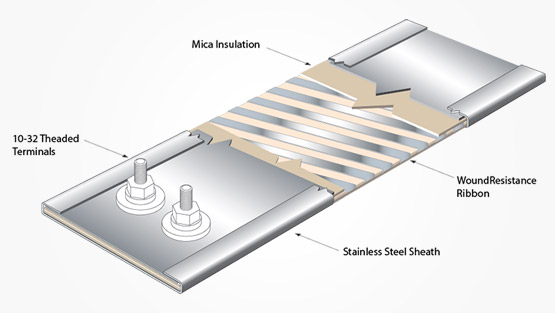
Reliable heat in industrial settings depends on more than wattage ratings and voltage charts. Behind every dependable industrial heater is a carefully engineered combination of materials and construction techniques that determine how long it will perform under stress. Understanding what makes heater elements durable helps manufacturers and facility managers choose components that withstand demanding environments without frequent failure.
High-Grade Nickel-Chromium Resistance Wire Composition
At the core of many heater elements lies nickel-chromium resistance wire. This alloy is selected for its ability to produce consistent heat while resisting deformation at high temperatures. High-grade compositions maintain stable electrical resistance even after repeated heating cycles, which reduces performance drift over time. Lower-quality wire may oxidize faster or lose structural integrity when exposed to sustained heat. Premium nickel-chromium alloys resist scaling and surface breakdown, especially in industrial heater applications that operate continuously. By maintaining uniform conductivity and shape, this wire helps ensure predictable output and long-term durability.
Superior Dielectric Strength of Internal Magnesium Oxide
Inside many industrial heater assemblies, magnesium oxide functions as both an insulator and a heat conductor. Its dielectric strength protects the resistance wire from electrical shorts while still allowing heat to transfer efficiently to the sheath. Dense, high-purity magnesium oxide improves performance significantly. Inferior insulation may absorb moisture or develop voids that reduce its insulating capacity. Strong dielectric properties prevent electrical leakage and help heater elements maintain consistent operation even in environments where vibration and thermal stress are common.
Oxidation Resistance of Stainless Steel or Incoloy Sheaths
The outer sheath of a heater element shields internal components from mechanical damage and chemical exposure. Stainless steel and Incoloy are often chosen because they resist oxidation at elevated temperatures. These materials form protective oxide layers that slow further corrosion. Harsh industrial environments expose heaters to air, moisture, and chemicals. Without oxidation-resistant sheaths, the surface can pit and weaken. Durable sheath materials extend the life of both standard strip heaters and strip heater configurations by preserving structural strength under heat and exposure.
Integrity of High-Temperature Moisture-Resistant Seals
Seals located at the ends of heater elements prevent moisture from entering the insulation layer. High-temperature sealing compounds maintain flexibility and adhesion even under extreme heat. If seals degrade, moisture infiltration can lead to electrical faults.
Well-designed seals are engineered to withstand temperature swings without cracking. Over time, poor sealing materials may shrink or separate from the sheath. Durable seals protect internal magnesium oxide insulation and preserve electrical integrity in industrial heater systems.
Uniformity of Internal Mineral Insulation Compaction
The way insulation is packed inside heater elements directly affects heat transfer and electrical isolation. Uniform compaction eliminates air gaps that could cause uneven heating or hotspots. Properly compacted insulation distributes thermal energy evenly across the sheath.
Uneven packing increases the risk of localized overheating. Consistent mineral density stabilizes performance and extends lifespan. Precision compaction is especially important in strip heaters and strip heater assemblies where uniform surface temperature supports process control.
Precision Centering of Internal Heating Coils
The internal resistance coil must remain centered within the sheath. If the coil shifts toward one side, it can create hot spots and reduce insulation thickness in critical areas. Precise centering ensures even spacing between the coil and sheath wall.
Manufacturing accuracy plays a significant role here. Tight tolerances during assembly prevent misalignment that might shorten operational life. Consistent centering helps industrial heater systems maintain stable output without premature burnout.
Resilience Against Repeated Thermal Expansion Cycles
Heater elements expand when heated and contract as they cool. Repeated thermal cycling can strain materials if they are not designed for flexibility. High-quality components accommodate expansion without cracking or losing structural stability.
Metals and insulation materials must work together during these cycles. A durable design allows components to move slightly while maintaining electrical and thermal performance. This resilience is critical in industrial heater applications that start and stop frequently.
Robustness of Heavy-Duty Electrical Connection Terminals
Connection terminals link heater elements to power sources. Weak terminals can loosen, corrode, or overheat under load. Heavy-duty terminals resist vibration and maintain solid electrical contact even in demanding environments.
Secure terminal construction reduces resistance at connection points. Stable connections help prevent arcing and overheating. Strong terminals also simplify maintenance and support long-term reliability for strip heaters and other industrial heater types.
Enhanced Surface Finish to Minimize Corrosion and Pitting
Surface finish affects both durability and heat transfer. Smooth finishes reduce the accumulation of contaminants and minimize corrosion initiation points. Pitted surfaces can weaken the sheath and compromise structural integrity.
Improved finishing techniques help industrial heater elements withstand moisture and chemical exposure. A refined surface slows corrosion progression and maintains appearance. Over time, this attention to detail supports extended service life and dependable output.
Thermal Corporation designs and manufactures heater elements built around material quality, precision assembly, and performance consistency. Their expertise in industrial heater technology ensures components are engineered to endure demanding applications. By focusing on durable construction and proven materials, Thermal Corporation provides heating solutions that perform reliably over extended operational cycles.